
Sep 23, 2026Buying Guides
CE Certification for Aerial Work Platforms (MEWPs) – A Straight Talk from a Veteran
CE for MEWPs: NB mandatory (Module B+D) per EN 280. Buyers: verify NB#, scope, new EU Reg 2023/1230 (2027). Avoid fakes.
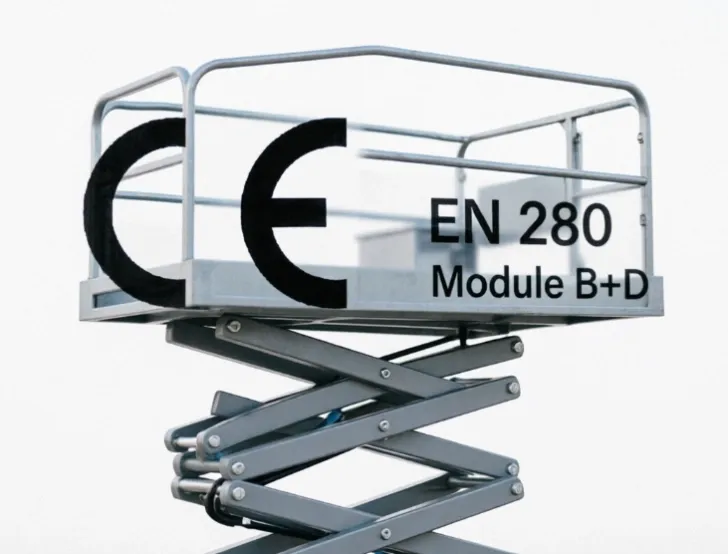
With over a decade in this business, I’ve handled CE certification more times than I can count. Let me be honest with you: CE is not a piece of paper – it’s a whole compliance system. Aerial work platforms (MEWPs) are high‑risk machinery, so the certification requirements are strict. I’ll break it down for you in three parts.
1. What Are the Available CE Certification Routes?
MEWPs fall under Annex IV of the Machinery Directive 2006/42/EC as high‑risk machinery, so you cannot just pick any route. Here are the main options:
Module | Description | Applicability for MEWPs |
|---|---|---|
Module A (Internal production control) | Manufacturer self‑declares compliance. | Not applicable – MEWPs usually require a Notified Body. |
Module B + C (Type‑examination + conformity to type) | Notified Body issues an EU type‑examination certificate; manufacturer then ensures production conformity. | Basic combination, but less common for MEWPs. |
Module B + D (Type‑examination + production quality assurance) | Notified Body audits both the design and the factory production control (FPC). | The most common route for MEWPs. |
Module H (Full quality assurance) | Covers design, production, installation, and service. | Used by large‑volume, multi‑model manufacturers. |
Key takeaway: As an Annex IV machine, an MEWP must involve a Notified Body (NB). If a certificate doesn’t show an NB number, treat it with extreme caution.
2. What Should Manufacturers Pay Attention To? (Advice for Suppliers)
a) Standards
- Core standard: EN 280 (Design, safety requirements and test methods for MEWPs).
- Complement with EN ISO 12100 (Risk assessment) and EN 60204‑1 (Electrical safety).
- Noise tests if applicable; pressure equipment may need PED.
- Be aware of standard versions – EN 280 has 2013, 2022, and 2023 editions. Don’t submit old versions for new certification.
b) Technical Documentation Must Be Complete
The technical file is the backbone of certification. It must include:
- Design drawings and calculation notes (structural strength, stability).
- Risk assessment per EN ISO 12100.
- Certificates for critical components.
- Test reports (static load, dynamic load, stability, emergency lowering, etc.).
- Multilingual operator manuals and safety markings.
- EC Declaration of Conformity (DoC).
Many failures happen because the technical file is incomplete – especially missing calculation sheets for critical parts.
c) Sample vs. Production Consistency
The sample tested must be identical to mass‑produced units. Some manufacturers send a “showpiece” and cut corners in production – if EU market surveillance catches this, the consequences are severe.
d) Document Retention Period
Technical files must be kept for at least 10 years from the last date of manufacture. Don’t think you’re done once you get the certificate.
e) Design Changes Require Re‑assessment
Any design change – even a different hydraulic valve or motor – may affect conformity and requires re‑evaluation.
3. What Should You, as the Buyer, Focus On?
a) Check the Certificate – But Don’t Stop There
- Verify the Notified Body number (4‑digit NB number) is clearly printed on the certificate.
- Cross‑check the NB’s accreditation on the EU NANDO database.
- Distinguish between “self‑declaration” and “Notified Body certification” – the former is not sufficient for MEWPs.
b) Confirm the Scope
Does the certificate explicitly list the model and specification you are buying? Some manufacturers use one model’s certificate to “cover” all others – that’s illegal.
c) Request the Full Documentation
As a buyer/user, you have the right to ask for:
- The EC Declaration of Conformity (DoC).
- The EC type‑examination certificate from the Notified Body.
- Operator manuals in the language of the destination market.
d) Check the Standard Version and Validity
Ask which version of EN 280 was used for certification. Important: From 14 January 2027, the new Regulation (EU) 2023/1230 will mandatorily replace the current Machinery Directive 2006/42/EC. If you buy equipment certified under the old directive now, its compliance may become problematic after that date – always ask your supplier about their transition plan.
e) Conduct On‑Site Audits (for larger orders)
If you’re placing a significant order, visit the factory to check:
- Whether production units match the tested sample.
- Whether the factory has a consistent production control (FPC) system.
- Whether the Notified Body performs annual surveillance audits.
f) Don’t Be Tempted by Bargain Prices
A proper CE certification (Module B+D) typically costs €10,000–25,000 and takes 7‑12 weeks. If someone quotes a few thousand RMB and promises a certificate in two weeks – it’s almost certainly fake.
Final Word from the Field
Over the years, I’ve seen too many buyers go for “CE‑certified” equipment at rock‑bottom prices, only to have it held at customs or, worse, cause accidents on site. These machines carry people – it’s a matter of life and death. CE isn’t a decoration; it’s a safety guarantee.
As a buyer, just asking a few simple questions – “What’s your NB number?”, “Which Notified Body issued it?”, “Which standard version?” – will filter out most unreliable suppliers. If you ever need a second pair of eyes on a supplier’s certificate, I’m happy to help. Just let me know.
Related reading