Sep 23, 2026Buying Guides
The “Safety Margin” Trap: Why Buying a Taller MEWP Doesn’t Mean Safer — And What We Did About It
Buying a taller MEWP than needed doesn’t add safety—it adds cost, weight, and site risks. The safety margin is already engineered in.
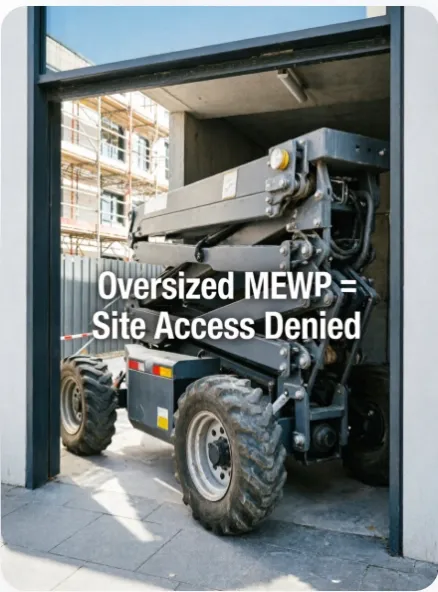
Title: The “Safety Margin” Trap: Why Buying a Taller MEWP Doesn’t Mean Safer — And What We Did About It
The Scenario
A mid-sized rental company in the UK came to us with a straightforward requirement: they needed MEWPs for routine building maintenance work. Their actual task height was 10 meters — cleaning exterior windows and replacing light fixtures on commercial buildings of three to four storeys.
But here’s where it got interesting. The procurement manager told me: “We actually need 10 meters, but we want to buy machines with a 12-meter working height. You know, just to have a safety margin. If we can reach 12 meters, we’ll feel safer working at 10 meters, right?”
It sounded logical. It sounded prudent. It sounded like exactly the kind of responsible decision any buyer should make.
It was also completely wrong.
What Went Wrong
The procurement manager had fallen into what I now call the “Safety Margin Fallacy” — the assumption that extra reach equals extra safety.
Here’s what he didn’t realize.
Misunderstanding #1: Working Height vs. Platform Height
He was comparing apples to oranges without knowing it.
A machine’s maximum platform height is the highest point the platform floor can reach. Its maximum working height is approximately 2 meters (about 6 feet) higher — the area an average-height person can reach while standing on the platform with arms extended overhead.
So when he asked for a “12-meter working height,” he was actually looking at a machine with a platform height of only 10 meters. That machine would get his operators’ feet to exactly where the work needed to be done — with no room for error, no comfortable reach, and certainly no “safety margin.”
Misunderstanding #2: The Real Safety Risks Come from Over-Specification
The bigger problem? Ordering a 20-meter working height machine instead of a 14-meter unit can almost double the weight — from 6 tonnes to 10 tonnes. That extra weight brings real safety hazards:
- Can the ground conditions or flooring support the additional weight?
- Will the machine even fit through site access points?
- Does the operator have the training and experience for a larger, more complex machine?
The most common mistake managers make when purchasing or renting aerial lifts is not choosing the right unit for the task. Not choosing the tallest — choosing the right one.
Misunderstanding #3: The “Margin” Is Already Built In
Here’s what most buyers don’t know: the safety margin is already engineered into the machine.
MEWPs are designed and tested according to rigorous standards like EN 280, which specifies structural design calculations, stability criteria, and safety examinations before machines are first put into service. Stability factors and tip-over safety margins are calculated into every machine’s rated capacity.
The machine’s maximum working height is not a “danger zone” — it’s a certified, tested, safe operating limit. Buying a taller machine doesn’t make the shorter working height safer. It just makes the machine bigger, heavier, more expensive, and harder to maneuver.
How We Fixed It
Instead of letting the client overspend on the wrong equipment, we walked them through a proper selection process.
Step 1: Clarify the Terminology
We started by clearly defining what they actually needed.
Term | Definition |
|---|---|
Task Height | The highest point where work needs to be performed |
Platform Height | Maximum height of the platform floor |
Working Height | Platform height + approximately 2m (operator’s reach) |
Their task height was 10 meters. To work comfortably at that height, they needed a platform height of approximately 8 meters, which would give them a working height of 10 meters.
Step 2: Match the Machine to the Actual Job
We followed IPAF’s MEWP selection framework, which covers height, reach, up-and-over height, the weight of people and materials, environment, restrictions, and site access.
The questions we asked:
- What is the exact highest point the operator needs to reach?
- Are there overhead obstacles that require extra outreach or up-and-over capability?
- What are the site access restrictions — width, height, ground conditions?
- How many people and how much material will be on the platform?
Step 3: Demonstrate the True Cost of Over-Specification
We showed them the numbers:
Specification | 10m Working Height Unit | 12m Working Height Unit |
|---|---|---|
Platform Height | ~8m | ~10m |
Approximate Weight | ~6 tonnes | ~10 tonnes |
Purchase Cost | Base | +30-40% |
Transport Cost | Standard | Higher (needs larger truck) |
Site Access | Most sites | Restricted |
The 12-meter unit wasn’t just more expensive to buy — it was more expensive to transport, harder to position on site, and risked being completely unsuitable for jobs with weight-sensitive flooring or narrow access points.
Step 4: Educate on the “Built-In” Safety Margin
We explained that the machine’s certified working height already accounts for safe operation. The structural design, stability calculations, and load ratings are all engineered to ensure the machine is safe at its maximum rated height.
What creates real safety is:
- Proper operator training (IPAF-certified)
- Correct machine selection for the task
- Thorough site risk assessment
- Regular maintenance and inspection
Not an extra 2 meters of boom.
The Outcome
The client purchased the correctly specified machines — 8-meter platform height units delivering a 10-meter working height.
The results:
- 30% lower capital cost compared to their original 12-meter specification
- Lower transport and logistics costs
- Better site access — the smaller units could fit through standard doorways and work on more job sites
- No safety incidents — and no operator ever felt “unsafe” at 10 meters
Six months later, the procurement manager told me: “I would have wasted a lot of money on machines I didn’t need. And worse — I would have put my operators in bigger, harder-to-handle machines for no good reason.”
Key Takeaways for Buyers
1. Know the difference. Working height is NOT platform height. Always check which number the specification sheet is quoting.
2. Don’t confuse size with safety. The safety margin is already engineered into every certified MEWP. Buying taller doesn’t mean buying safer — it often means buying less safe for the actual job conditions.
3. Match the machine to the task, not to a “feeling.” Use a laser measure or site plans to determine the exact height needed. Even being 1 meter short can create unsafe workarounds — but being 2 meters over creates its own set of problems.
4. Consider the full cost of ownership. A taller machine costs more to buy, more to transport, more to insure, and may limit the jobs you can bid on due to site access restrictions.
5. Work with a supplier who asks the right questions. If a supplier just takes your order without asking about site conditions, access restrictions, and the actual task — that’s a red flag.
Have you ever been tempted to “oversize” your equipment purchase for peace of mind? Let’s talk about what you actually need — and how to get it right the first time.
Related reading