
Sep 23, 2026Success Stories
Cold Storage, Hot Solution: How We Engineered a Series of Compact MEWPs for Sub-Zero Warehouses with Narrow Aisles
Cold storage client needed MEWPs for -18°C, 1.6m aisles, weak floors. Standard lifts failed. We developed GTW Series: 650mm wide, 750‑860kg, 200kg/2‑person, heights 6.6‑10.5m. Saved repair time 4h-2h
Title: Cold Storage, Hot Solution: How We Engineered a Series of Compact MEWPs for Sub-Zero Warehouses with Narrow Aisles
The Challenge: A Freezer That Stopped Conventional Lifts Cold
It started with a phone call from a cold chain logistics operator in the Midwest. Their facility was a massive frozen food distribution center — 40,000 square meters of storage space maintained at -18°C to -22°C, packed with towering racking systems and aisles so narrow that a standard pallet jack could barely pass through.
Their problem was straightforward but frustrating: they needed to perform routine maintenance on overhead sprinkler systems, lighting fixtures, and racking structures at heights ranging from 6 to 10 meters. But every conventional aerial work platform they tried was either:
- Too wide to enter the aisles
- Too heavy for the freezer's insulated floor structure
- Too tall in stowed height to fit through freezer doorways
- Unable to perform reliably in sub-zero temperatures
"In cold storage or food distribution areas, delays can also affect product handling and temperature-controlled workflow," their facility manager told us. "If the equipment is too large, it may block aisles and slow pallet movement."
They had a height problem. They had a space problem. And they had a temperature problem.
The wrong platform would lead to blocked access, unsafe workarounds, and lost productivity.
The Approach: Listening, Learning, and Engineering from the Ground Up
Our agent sales team visited the site. Our technical team studied the conditions. And together, we realized this wasn't a case of simply recommending an existing product off the shelf.
The cold storage environment presented three distinct engineering challenges:
Challenge 1: The Temperature Factor
Operating MEWPs in below-freezing environments impacts battery performance significantly. As a general rule, battery capacity drops by approximately 10% for every 15° to 20°F below 80°F. In a -18°C freezer, that meant conventional lead-acid batteries could lose up to 50% of their effective capacity, requiring more frequent charging and causing sluggish machine functionality.
Challenge 2: The Space Constraint
The facility's aisles were barely 1,600 mm wide. Standard scissor lifts and boom lifts — with widths typically exceeding 1,100 mm and large turning radii — simply couldn't navigate these tight corridors. Even if they could enter, their turning radius would make maneuvering between racking uprights nearly impossible.
Challenge 3: The Floor Load Limitation
The freezer floor was an insulated structural slab — not designed to support heavy equipment. Conventional lifts weighing 2,500 kg or more risked damaging the insulation layer or, worse, cracking the concrete.
We didn't have a product that checked all these boxes. So we built one.
The Solution: The GTW Series — Purpose-Built for Cold Storage
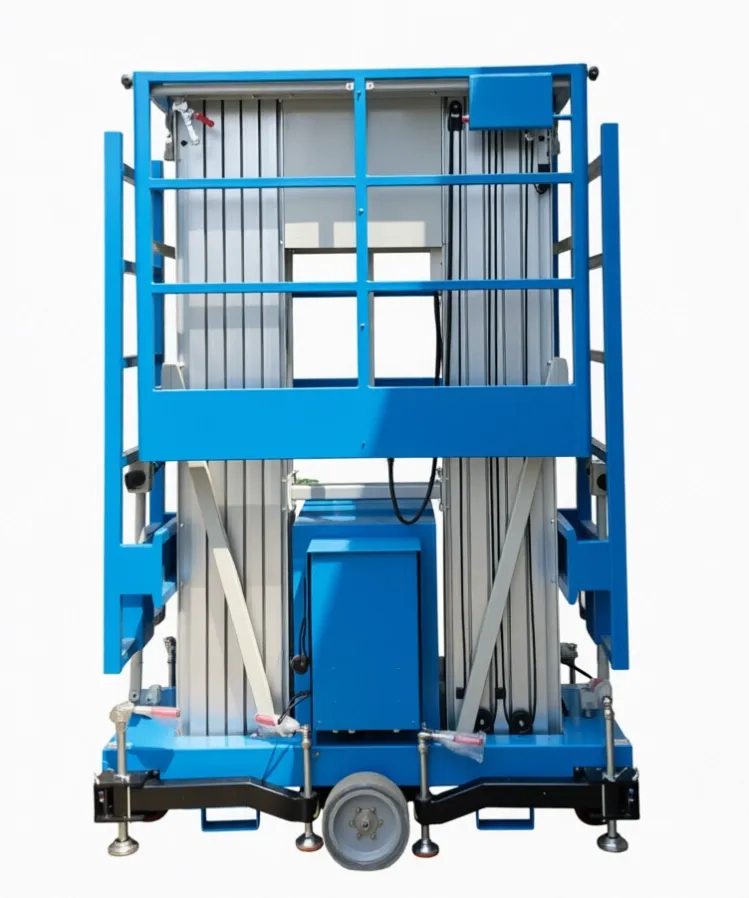
After months of collaboration between our engineering team and the client's facility managers — through multiple design iterations, prototype testing, and on-site validation — we developed a dedicated series of cold-storage-ready MEWPs: the GTW Series.
The series includes four models, each tailored to different height requirements within the facility:
Model | Max Platform Height | Rated Load | Persons | Platform Size | Outrigger Footprint | Stowed Dimension | Machine Weight |
|---|---|---|---|---|---|---|---|
GTWB11-201131L | 10.5 m | 200 kg | 2 | 1410×500 mm | 1983×1640 mm | 1800×650×2350 mm | 860 kg |
GTWB11-201132L | 10.5 m | 200 kg | 2 | 1280×500 mm | 1863×1575 mm | 1580×650×2350 mm | 820 kg |
GTWB7-200731L | 6.6 m | 200 kg | 2 | 1280×500 mm | 1863×1575 mm | 1580×650×2080 mm | 750 kg |
GTWR8-200831L | 8 m | 200 kg | 2 | 1280×500 mm | 1863×1575 mm | 1580×650×2160 mm | 766 kg |
What Made These Machines Different?
1. Ultra-Narrow Profile
With a stowed width of just 650 mm, every model in the GTW Series could navigate aisles as narrow as 1,600 mm with room to spare. The compact footprint meant operators could position the machine precisely between racking uprights without blocking adjacent aisles.
2. Remarkably Lightweight Construction
Weighing between 750 kg and 860 kg — less than one-third the weight of comparable scissor lifts — these machines placed minimal stress on the freezer's insulated floor. The GTWB7-200731L, at just 750 kg, could be maneuvered by a single operator without risk of floor damage.
3. Cold-Weather Battery System
We equipped each machine with a DC 1.2 kW motor and a battery system optimized for low-temperature operation. Insulated battery compartments protect against thermal cycling, while the charging protocol ensures batteries are maintained at optimal temperatures — preventing the capacity loss that plagues conventional lifts in cold environments.
4. Full-Height Access with Minimal Footprint
Despite their compact size, these machines deliver working heights from 8.6 meters to 12.5 meters (platform height + 2m operator reach) — covering every overhead maintenance point in the facility. The outrigger footprints, ranging from 1,863×1,575 mm to 1,983×1,640 mm, provide stable operation even at full extension.
5. Two-Person Capacity
With a 200 kg rated load and space for two persons, maintenance teams could work together — one operator controlling the platform while the other performed the repair — reducing task completion time significantly.
The Outcome: Measurable Results in Sub-Zero Conditions
Before the GTW Series:
- Overhead maintenance required shutting down entire aisle sections
- Maintenance crews used ladders and scaffolding — slow, unsafe, and non-compliant with OSHA standards
- Average repair time for a single overhead fixture: 4–6 hours
- Cold exposure time for maintenance crews: extended and unsafe
After Deploying the GTW Series:
- Aisle blockage reduced by 90% — the 650 mm width meant machines could operate without disrupting pallet movement
- Average repair time cut to under 2 hours — the ability to position precisely and work at height with two people transformed productivity
- Zero floor damage incidents — the sub-900 kg weight kept the insulated slab intact
- Battery performance remained consistent — even after full shifts in -18°C conditions
- Maintenance crews reported fewer cold-related delays — faster work meant shorter exposure times
"We went from dreading overhead maintenance to actually scheduling it proactively," the facility manager told us six months after deployment. "These machines are the first ones that actually work in our environment — not just tolerate it, but work in it."
Key Takeaways for Cold Storage Operators
1. Don't assume standard equipment will work in cold environments. Temperature affects batteries, hydraulics, and lubricants. If your supplier isn't asking about operating temperatures, they're not taking your environment seriously.
2. Width matters more than you think. In narrow-aisle warehouses, every centimeter counts. A machine that's 100 mm too wide can render an entire aisle inaccessible.
3. Weight is a hidden risk. Insulated floors in cold storage facilities are not designed for heavy equipment. A lightweight machine isn't just convenient — it's essential for facility safety.
4. Two-person capacity transforms productivity. Sending one person up to diagnose and another up to repair doubles the time. A 200 kg capacity with space for two means the job gets done in half the time.
5. The right solution might not exist yet — but that doesn't mean it can't be built. Our GTW Series was born from a single client's need. Today, it's a product line serving cold storage facilities across three continents.
Are you operating in a cold storage environment with narrow aisles and weight-sensitive floors? We've been there. We've solved it. Let's talk about what the GTW Series can do for your facility.
About the Author
With nearly 20 years in aerial work platform sales and 6 years of international procurement experience, we understand both sides of the equipment equation — what buyers need and what suppliers can deliver. The GTW Series is proof that the best solutions come from listening to the customer first and engineering second.
Related reading