
Aug 7, 2026Buying Guides
How to Solve Aerial Work in Confined Spaces? A 20‑Year Product Manager’s Proven Playbook
Compact lifts (<2m), booms, mini scissors, pre‑assembly, drones, and strict safety (ventilation, dual‑lanyard, video) solve confined aerial work. Tailored solutions from a 20‑year expert.
How to Solve Aerial Work in Confined Spaces? A 20‑Year Product Manager’s Proven Playbook
Keywords: confined space aerial work, narrow access work platforms, spider lifts, articulating boom lifts, working at height in tight areas
In scenarios like old residential renovations, shopping mall atrium repairs, or subway station construction, the common headache is “big machines can’t enter, and small ones can’t reach high enough.” Having spent two decades as a product manager in the access industry, I’ve developed a systematic approach based on “precision equipment + innovative methods + uncompromising safety” – helping clients achieve maximum efficiency and safety with the smallest spatial footprint.
I. Smart Equipment Selection – Three Specialised Machines for Tight Spots
Choosing the right machine solves half your problem. Here are my top‑tested performers:
1. Spider‑Type Aerial Work Platforms – The “All‑Terrain Transformer”
- Why choose it? Retracted width under 2 metres – easily passes through standard doorways and corridors. Tracked or wheeled, even rail‑road convertible, handling mud, steps, and slopes.
- Stability? Independently adjustable hydraulic outriggers level the machine on irregular ground; real‑time tilt monitoring ensures maximum safety.
- Best for: old building facade repairs, subway pipe installation, indoor glass curtain wall cleaning.
2. Articulated Boom Lifts – The “Flexible Arm” That Bypasses Obstacles
- Key advantage: Multi‑section booms fold, bend, and rotate – like an arm that “reaches around” pipes or light fixtures to access the work point horizontally.
- Zero tail‑swing: Minimal rear overhang during extension/rotation – perfect for cluttered workshops or narrow corridors.
- Best for: shopping mall ceiling HVAC maintenance, office exterior cladding, stadium roof steel welding.
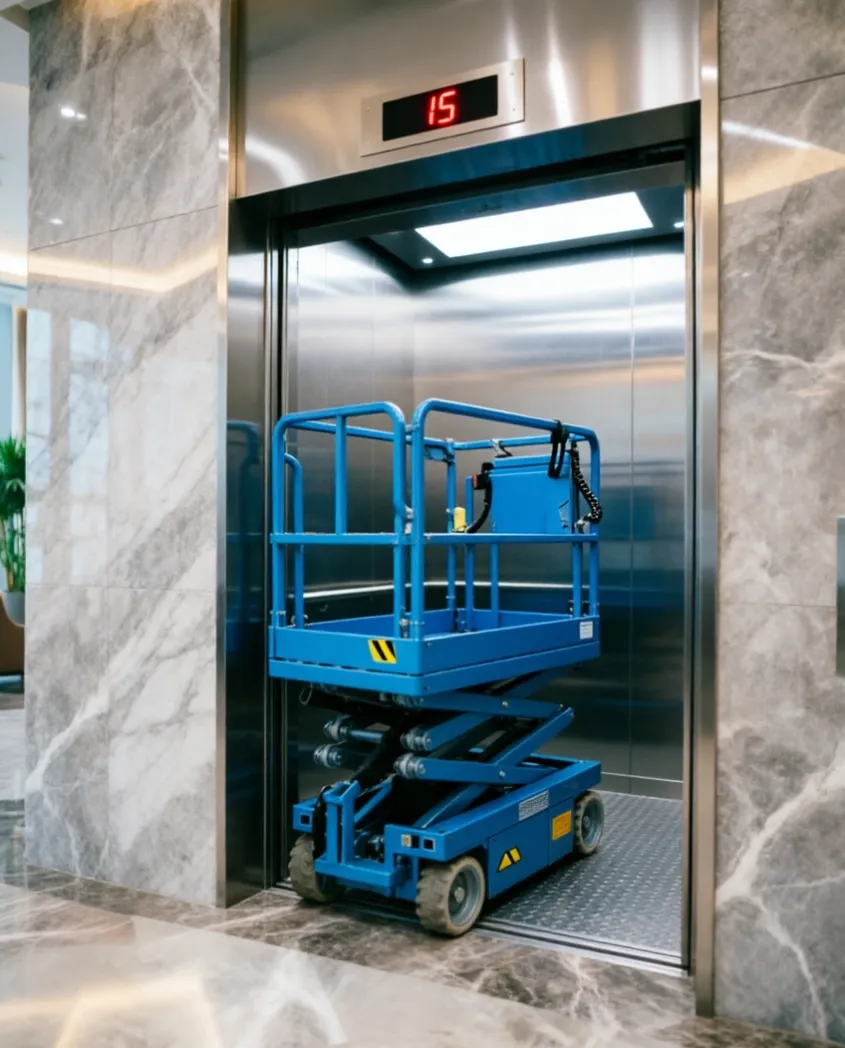
3. Mini Scissor & Mast‑Type Lifts – The “Pocket‑Sized” that Fit Into Elevators
- Ultra‑compact: Mini scissor lifts ~1 metre wide; mast types as slim as 650 mm – can roll into passenger lifts for seamless floor‑to‑floor transfer.
- Floor‑friendly: Low ground pressure – won’t damage raised access floors or epoxy coatings in clean rooms.
- Best for: retail lighting replacement, hotel lobby cleaning, factory equipment inspection, warehouse high‑bay restocking.
II. Method Innovation – When Equipment Can’t Reach, We Rethink the Process
Often, it’s not the machine’s fault – we need to change the workflow. Here are three veteran tricks:
- Ground Pre‑Assembly: Move all high‑altitude assembly (steel frames, ducts) to the ground. Then use a small hoist to lift the complete unit – reducing elevated work by over 70% and cutting risks dramatically.
- Custom Non‑Standard Tools: For complex roof structures, design special suspended platform installation methods. When bridge girder gaps are only 50 cm wide, we fabricate foldable, movable work decks so workers have solid footing.
- High‑Tech “Helpers”:
- Drones/Flying Robots: Perform equipment lifting or close‑up inspection in extremely confined or hazardous zones.
- Lightweight Climbing Systems (e.g., C‑shaped crawlers): Used in mountainous bridge pier construction – no need for large cranes.
- Exoskeleton Suits: Assist workers in carrying heavy loads and maintaining balance in narrow spaces, reducing fatigue and improving productivity.
III. Safety Management – The Tighter the Space, the More Robust the Protection
In confined spaces, rescue is extremely difficult. Our safety measures must be “predictive and redundant.”
- Ventilate first, test second, then enter – check air quality, toxic gas levels, and ensure clear escape routes.
- Double‑layer personal protection – mandatory full‑body harness with “high anchor, low tie‑off”; use dual‑lanyard fall arresters so one lanyard is always attached during movement.
- Underneath shielding – install safety nets and protected walkways below the work zone to catch falling objects.
- Real‑time visual monitoring – deploy audible alarms and industrial cameras; supervisors can watch remotely and stop work instantly if anomalies appear.
IV. Management Upgrades – Digital Planning & Contingency
- Specific Risk Assessment + Permit‑to‑Work: Each confined space job gets an individual risk analysis and sign‑off.
- BIM Simulation: Pre‑simulate equipment access routes and worker positions to detect collisions and optimise traffic flow.
- Multi‑party Scheme Review: For complex projects, bring together design, construction, and equipment teams for joint drills.
- Enhanced Training: Regular confined‑space emergency drills ensure every worker knows evacuation and first‑aid procedures by heart.
V. Frequently Asked Questions (FAQ)
Q: Does a spider lift require special flooring?
A: With hydraulic outriggers, ground pressure is adjustable. Standard concrete is fine; for soft soil or grass, use steel plates to distribute load.
Q: How high can a mini scissor lift reach?
A: Typically 6–10 metres. For higher needs, choose mast or spider types, which can reach up to 20+ metres.
Q: Rent or buy?
A: For short‑term projects, rental is cost‑effective. For long‑term repetitive use, we offer flexible financing and sale‑leaseback options.
Final Word: Working at height in confined spaces demands a deep understanding of space, equipment, and people. There’s no one‑size‑fits‑all – only tailored solutions. If you’re facing similar challenges, bring us your site photos and dimensions, and we’ll craft a customised plan for you.