
Sep 22, 2026Buying Guides
Crawler Scissor Lifts with Hydraulic Outriggers: A Compact Buying Guide
Crawler scissor lifts with hydraulic outriggers for gravel, mud, slopes. Outstrip 0614TL–1214TL: 8–13.8m height, 320–550kg capacity, 0.5° leveling, 1.61m width. Guide covers specs and selection.
Introduction: When a Standard Scissor Lift Won't Work
Standard scissor lifts are built for level, paved ground. If your site has gravel, mud, slopes, or finished floors you can't damage, a wheeled lift will sink, tilt, or get stuck.
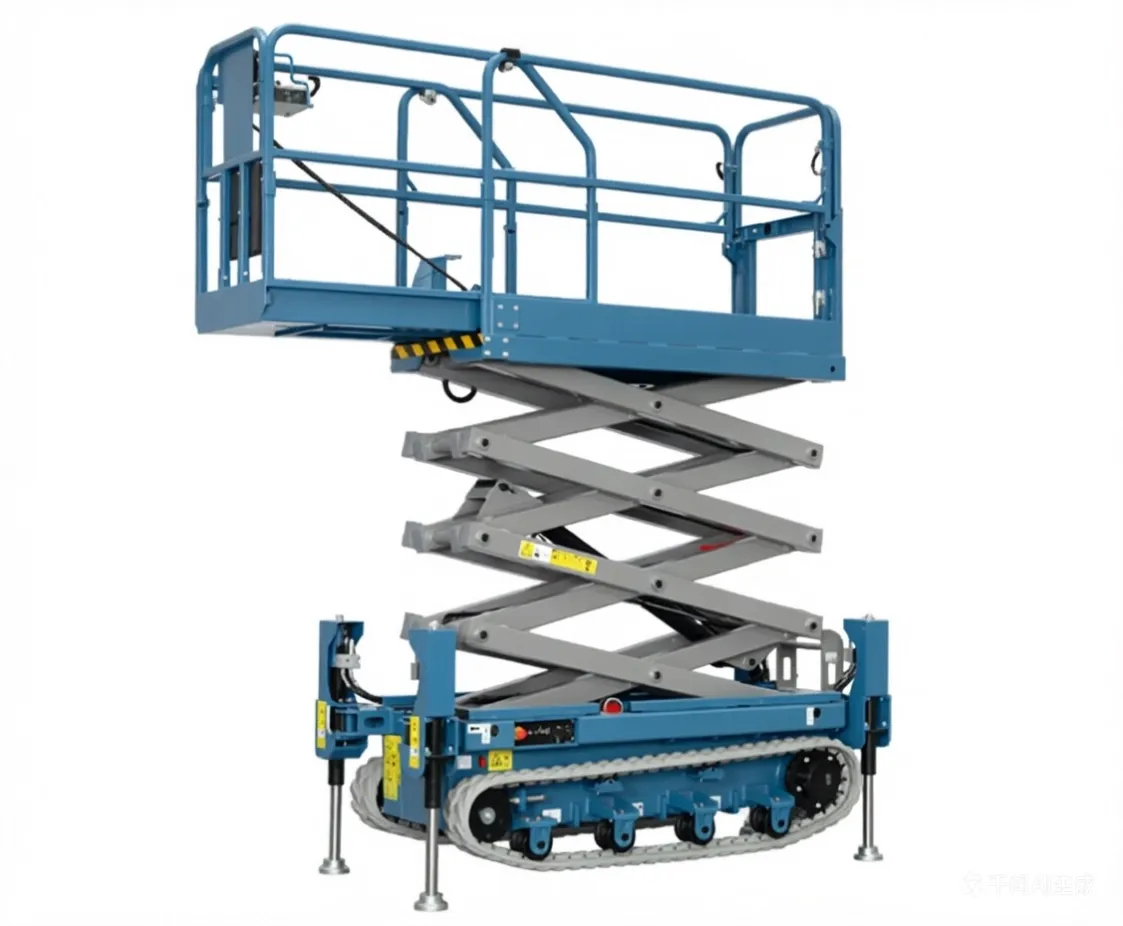
Crawler scissor lifts with hydraulic outriggers solve this problem. The Outstrip 0614TL–1214TL series is a proven example of this equipment category — view the full product specifications here. Here's what to know before you buy.
1. What Ground Are You Working On?
Be honest about the worst conditions, not the best.
Wheeled lifts fail on:
- Loose gravel or crushed stone
- Mud or soft soil after rain
- Sand or slopes
- Finished surfaces (marble, membrane roofing)
Why crawler tracks work: Rubber tracks spread weight over a larger area, reducing ground pressure. They grip on loose, wet, or uneven surfaces where wheels spin or sink.
What to specify: The worst ground condition the machine will face.
2. How Level Does the Platform Need to Be?
The Outstrip 0614TL–1214TL series is rated for 0.5° maximum working inclination with outriggers deployed.
That's not a limitation — it's a guarantee. When the outriggers deploy, the platform is truly level, regardless of the slope beneath the tracks.
How it works: Independent hydraulic outriggers extend until they contact the ground, then auto-adjust the frame until the platform is horizontal. The platform's levelness is decoupled from the terrain.
What to specify: The steepest slope where the machine will be positioned. If it exceeds 30%, you need a different solution.
3. Height vs. Capacity: Which Model?
As height increases, capacity decreases. Choose based on your load at the highest work point.
Model | Max. Working Height | Platform Height | Capacity (Outriggers Deployed) | Weight |
|---|---|---|---|---|
0614TL | 8.0 m | 6.0 m | 550 kg | 2,835 kg |
0814TL | 9.9 m | 7.9 m | 460 kg | 3,000 kg |
1014TL | 11.8 m | 9.8 m | 320 kg | 3,375 kg |
1214TL | 13.8 m | 11.8 m | 320 kg | 3,900 kg |
Example: Need to carry 400 kg to 12 meters? No model in this series will do it. Rethink the task or stage materials differently.
What to specify: Your actual load at the highest work point.
4. Do You Always Need Outriggers?
No. On level concrete — indoor warehouses, factory floors — you may not need them.
Without outriggers:
- Faster repositioning between work points
- Access to tighter spaces
- Smoother workflow
Trade-off: Capacity may be reduced. The safety interlock prevents elevation unless outriggers are correctly deployed — this is non-negotiable.
What to specify: Whether your primary surface is level or uneven.
5. Power Source: Does It Work Indoors?
The series runs on 48V DC with 8 × 6V 220Ah AGM batteries and AC drive motors.
Why it matters:
- Zero emissions — safe for indoor use without ventilation
- Quiet operation — hospitals, schools, residential areas
- Maintenance-free batteries — no watering, no acid spills
Diesel or propane is not viable indoors.
What to specify: Indoor, outdoor, or both. For extreme cold (below -20°C), a cold-weather battery kit is available.
6. How Tight Is Your Workspace?
Despite the track system and outriggers, the series maintains a width of just 1.61 m with zero inside turning radius.
What zero turning radius means: The machine pivots 360° around its own center. No turning circle. No tail swing.
Applications:
- Narrow refinery pipe racks
- Greenhouse aisles
- Warehouse racking (no collision with uprights)
- Bridge maintenance walkways
What to specify: The narrowest passage the machine must traverse. Allow margin beyond 1.61 m.
7. What Safety Features Are Essential?
Verify these are present on any crawler lift you consider:
Feature | Why It Matters |
|---|---|
Outrigger interlock | Prevents elevation unless outriggers are deployed — eliminates tip-over risk |
Tilt level protection | Warning if slope is excessive — prevents unsafe operation |
Overload protection | Prevents lifting beyond capacity |
Emergency lowering | Allows descent if power fails |
Emergency stop | Dual-location shutoff (platform + ground) |
Descent alarm | Alerts ground personnel during lowering |
What to specify: Confirm CE, ANSI, or AS1418 certification — not optional labels, but third-party verification.
Decision Framework
Step 1: Required working height?
- 8.0 m → 0614TL
- 9.9 m → 0814TL
- 11.8 m → 1014TL
- 13.8 m → 1214TL
Step 2: Required load at height?
- 550 kg → 0614TL only
- 460 kg → 0814TL only
- 320 kg → 1014TL or 1214TL
Step 3: Surface conditions?
- Level indoor → Consider skipping outriggers
- Uneven/sloped outdoor → Deploy outriggers every task
Pre-Purchase Checklist
# | Question | Your Answer |
|---|---|---|
1 | Ground condition (gravel, mud, slope, finished) | ______ |
2 | Maximum slope angle | ______ |
3 | Required working height | ______ |
4 | Required load at max height | ______ |
5 | Indoor, outdoor, or both | ______ |
6 | Narrowest passage width | ______ |
7 | Required certifications | ______ |
Final Thoughts
Crawler scissor lifts with hydraulic outriggers are not "better" scissor lifts — they're different. They're built for slopes, soft ground, uneven surfaces, and narrow access where wheeled lifts can't perform safely.
If your ground is level and paved, a standard lift is cheaper and simpler. If it isn't, this category is the right answer.
Need help matching a model to your site? View the complete Outstrip crawler scissor lift specifications, or share your ground conditions and height requirements — we'll recommend what fits.