Sep 23, 2026Buying Guides
The 12 Questions You Must Answer Before Buying a MEWP – A Complete Buying Guide
Answer 12 questions before buying a MEWP: height, load, power, obstructions, ground, access, color, movement. This guide helps you specify the right machine and avoid costly mistakes.
Introduction: Why Most Buyers Get It Wrong
I've spent nearly 20 years in the aerial work platform industry. And if there's one thing I've learned, it's this: most buyers don't know what they actually need until you ask the right questions.
A customer calls and says, "I need a 10-meter lift." But what does that mean? Platform height or working height? Indoors or outdoors? Through a standard door or a freight elevator? On concrete or on a mezzanine floor with weight restrictions?
The difference between getting it right and getting it wrong is not about the machine — it's about the questions you ask before you buy.
Over the years, we've developed a structured design parameters table that guides every customer through the specification process. It's saved clients from costly mistakes, delivered machines that actually fit their sites, and prevented countless "I wish I'd thought of that" moments.
Below, I've turned that table into a question‑and‑answer buying guide. If you can answer these 12 questions honestly and accurately, you'll never buy the wrong MEWP again.
Question 1: What is the maximum platform height (lifting height) you need?
Why this matters: Platform height is the height of the platform floor from the ground when fully elevated. This determines whether your workers can physically reach the work point with their feet on the platform.
Common mistake: Many buyers confuse platform height with working height. Platform height is where your feet stand. Working height adds approximately 2 meters (about 6 feet) to account for the worker's arm reach. If you need to work at a 10‑meter ceiling, you only need an 8‑meter platform height — not a 10‑meter one.
What to specify: The exact height from the ground to where your workers' feet need to be when standing on the platform.
Question 2: What is the maximum working height you need?
Why this matters: Working height is the height of the highest work point your operators need to reach from the ground. This is the number that really matters in the field.
How to calculate: Working height = Platform height + approximately 2 meters (the reach of an average worker with arms extended overhead).
Common mistake: Sizing a lift by platform height alone and ending up with a machine that's 2 meters short of what you actually need.
What to specify: The distance from the ground to the highest point where work needs to be performed.
Question 3: What is the minimum platform height you need?
Why this matters: Some applications require the platform to lower to a specific height — for example, to load materials at ground level, to clear doorways during transport, or to access low‑level work points without moving the machine.
Common mistake: Assuming every machine lowers to ground level. Some models have a minimum platform height above zero — and that can be a deal‑breaker if you need ground‑level access.
What to specify: If you need the platform to lower to a specific height (e.g., 500mm for loading), state it clearly. If not, the standard minimum (typically ground level) will apply.
Question 4: What is your load capacity requirement?
Why this matters: Load capacity determines how many people and how much equipment can be on the platform at once. Under‑specifying means you can't carry what you need. Over‑specifying means you're paying for capacity you don't use — and carrying extra weight that may exceed floor load limits.
Common mistake: Forgetting to include tools, materials, and equipment in the total weight. The worker's weight is only part of the equation.
What to specify: Total weight = Number of persons × average weight + weight of all tools and materials to be carried to height.
Question 5: What is the main working purpose?
Why this matters: The type of work determines the type of machine. Maintenance work in a warehouse requires different features than construction work on a building site.
Examples:
- Overhead lighting replacement in a factory
- Sprinkler system maintenance in a cold storage facility
- Racking system inspection in a warehouse
- Exterior building maintenance
- Electrical or plumbing installation at height
Common mistake: Buying a general‑purpose machine when the application requires specific features — like non‑marking tires for indoor floors, cold‑weather battery systems for freezers, or extra platform length for continuous overhead access.
What to specify: A clear description of the primary tasks the machine will perform.
Question 6: What is your power source (voltage and frequency)?
Why this matters: MEWPs can be powered by diesel, electric batteries, or direct AC power. The power source must match your site's available supply.
For indoor work: Electric‑powered models are preferred to eliminate emissions.
For outdoor work: Diesel‑powered machines may offer longer run times.
Common mistake: Ordering a machine with the wrong voltage or frequency for the local electrical supply. A 60Hz machine won't work properly on a 50Hz system — and vice versa.
What to specify: Your local voltage and frequency (e.g., 220V/50Hz, 110V/60Hz, 380V/50Hz three‑phase).
Question 7: Are there obstructions within the range of the lift?
Why this matters: Overhead obstructions — pipes, beams, lighting fixtures, conveyor systems, robotic arms — can prevent the machine from reaching the work point or from elevating safely.
Common mistake: Assuming the machine can elevate straight up without checking what's overhead.
What to specify: If yes, list the location, size, and height of each obstruction. This is critical for designing the machine's platform configuration, outrigger placement, and movement path.
Question 8: What are the ground conditions — slopes, steps, or other obstacles?
Why this matters: MEWPs require firm, level ground for safe operation. Slopes, steps, uneven surfaces, or soft ground can make a machine unstable — or prevent it from reaching the work area at all.
Key consideration: Gradeability — the maximum slope angle a MEWP can drive up or down in the stowed position. If your site has ramps or inclines, you need a machine with adequate gradeability.
Common mistake: Assuming a machine can operate on any surface. Some machines require perfectly flat concrete. Others can handle uneven terrain with outriggers or stabilizers.
What to specify: Describe the ground surface (concrete, asphalt, gravel, soil), any slopes or steps, and the condition of the floor (smooth, uneven, cracked, etc.).
Question 9: Are there passages such as doors, elevator cabs, or other access points?
Why this matters: This is one of the most overlooked factors — and one of the most common reasons machines don't work on site. If the machine doesn't fit through the door, it doesn't get to the job.
What you need to measure:
- Doorway width and height
- Elevator cab dimensions (length, width, height, and door size)
- Corridor widths
- Any other access restrictions
Common mistake: Measuring the doorway but forgetting the elevator's interior dimensions. A machine might fit through the door but not inside the cab.
What to specify: Detailed dimensions of every access point the machine must pass through — length, width, and height.
Question 10: Are there special requirements for equipment appearance color?
Why this matters: In many industries — especially food processing, cold storage, and pharmaceutical manufacturing — equipment must match specific color codes for safety, branding, or hygiene standards.
Common mistake: Assuming standard factory colors are acceptable.
What to specify: If you have a specific color requirement (e.g., RAL number or brand color), state it. If not, the factory standard color will apply.
Question 11: How will the machine be moved?
Why this matters: The moving method determines how the machine is positioned, how easily it can be relocated between work points, and whether it can be moved while elevated.
Options and when to choose them:
Moving Method | Best For |
|---|---|
Manual push around | Small, lightweight machines; occasional use; tight budgets |
Electric power walking | Frequent repositioning; indoor use; operator‑friendly |
Self‑propelled when fully lifted | Continuous workflow along long corridors or production lines; maximum productivity |
Trailer type | Outdoor use; transport between multiple sites |
Common mistake: Choosing manual push for a machine that's too heavy to push, or choosing self‑propelled when the machine only needs to move between a few fixed points.
What to specify: Your working scope — how many work points you need to access, how frequently, and the distance between them.
Question 12: Are there any other special requirements?
Why this matters: Every site is unique. There's always something that doesn't fit neatly into a checklist.
Examples of "other" requirements:
- Non‑marking tires for polished floors
- Cold‑weather battery systems for freezer environments
- Special guardrail configurations
- Custom platform extensions
- Remote control operation
- Leak protection to prevent hydraulic oil spills
What to specify: Anything else that's important to your application, no matter how small it seems.
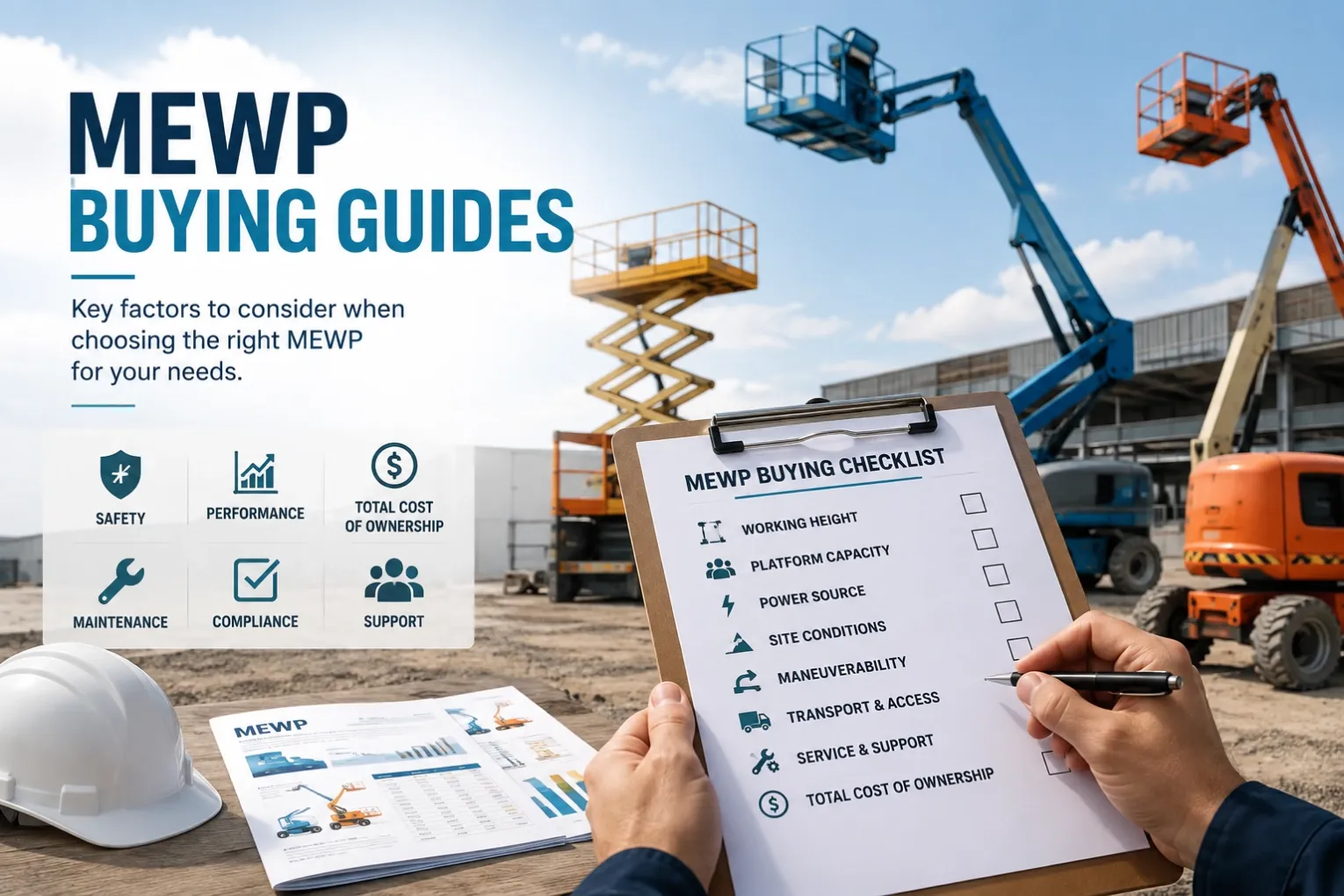
Summary: The Pre‑Purchase Checklist
Before you contact any supplier, go through these 12 questions. Write down your answers. Take measurements. Walk your site with a tape measure and a notepad.
The more information you provide upfront, the better the solution you'll receive.
# | Question | Your Answer |
|---|---|---|
1 | Max platform height | ______ |
2 | Max working height | ______ |
3 | Min platform height | ______ |
4 | Load capacity (persons + tools) | ______ |
5 | Main working purpose | ______ |
6 | Power source (V/Hz) | ______ |
7 | Obstructions? | ______ |
8 | Ground conditions | ______ |
9 | Access passages (doors, elevators) | ______ |
10 | Special color requirements? | ______ |
11 | Moving method | ______ |
12 | Other requirements | ______ |
Final Thoughts
I've seen too many buyers skip these questions — and end up with machines that don't fit through the door, can't handle the weight, or simply can't reach the work point.
The machine that looks right on a spec sheet is rarely the machine that's right on site. The only way to know is to ask the right questions first.
Need help working through these questions for your specific site? We've been doing this for nearly 20 years. Send us your answers, and we'll help you find the machine that actually fits.
Related reading