
Sep 24, 2026Buying Guides
Choosing a MEWP for Hot, Humid and Dusty Job Sites — A Buyer's Checklist for the Gulf and Southeast Asia
Spec sheets assume temperate weather. Here is the engineering checklist Gulf and Southeast Asian buyers should use before choosing an aerial work platform for heat, dust and humidity.
Most MEWP specification sheets are written for a European spring. A machine rated for 25 °C ambient will spend its working life at 45 °C in Riyadh, at 90% relative humidity in Jakarta, and inside a sand-laden wind in Doha. The catalogue numbers do not change — but the machine's real behaviour does.
This guide is for buyers in the Gulf and Southeast Asia who are choosing aerial work platforms for genuinely difficult climates. It covers what heat, humidity and dust actually do to a MEWP, the six questions you should put to every supplier before you order, and how to match machine type to work scenario. No marketing gloss — just the engineering that decides whether your fleet is still productive in year three.
What Extreme Heat Actually Does to a MEWP
Heat does not usually destroy a machine in one dramatic failure. It degrades a dozen small things at once, and the effects compound:
- Hydraulic oil thins. As oil temperature climbs, viscosity falls and internal leakage increases. Lift speed drops, the system runs hotter again, and pump wear accelerates — a feedback loop that shortens component life.
- Electric drive systems de-rate. Motors, controllers and chargers have thermal cut-offs. In practical terms, the same machine that climbs confidently at 20 °C may feel sluggish after four hours in direct sun, or pause to cool.
- Battery capacity falls. Lead-acid capacity drops noticeably at high ambient temperatures, and sustained heat shortens lithium pack life. Charging in a 45 °C yard without ventilation is one of the fastest ways to kill a battery bank.
- Seals, hoses and paint age faster. UV exposure embrittles rubber and hydraulic hose covers. In coastal sites, salt accelerates corrosion at exactly the points that are hardest to repaint: welds, fasteners and pivot pins.
Humidity adds its own layer. Condensation forms inside control boxes and connectors when equipment cycles between a hot day and a cool night — the classic Gulf and tropical pattern. Left unmanaged, it becomes intermittent electrical faults that are expensive to diagnose.
IP Ratings and Motor Duty: What to Check Before You Order
Two specification lines separate a machine that survives this climate from one that does not.
IP rating. The IP (Ingress Protection) code tells you how well enclosures resist dust and water. For dusty sites, look for IP54 or better on control boxes, motors and charger enclosures — the second digit matters most where fine sand is airborne. Do not accept "suitable for outdoor use" as a substitute for a stated IP rating.
Motor duty rating. Motors are rated for an ambient temperature and a duty cycle. Ask directly: at what ambient temperature is this rating declared, and what is the continuous-duty figure at 45 °C? A supplier who cannot answer this question is telling you something important.
Battery thermal management. For electric machines, ask how the battery management system handles high-temperature charging, and whether the charger can be installed under shade. For diesel units, check that the cooling package is specified for the ambient temperature of your site, not the manufacturer's home market.
Documentation is the other half of the check. Every claim a supplier makes about certified components should come with a paper trail — our guide to CE certification for aerial work platforms explains what to verify and how to spot certificates that will not hold up.
Six Site Questions to Answer Before You Choose
Buyers who get this wrong usually skip straight to machine selection. Answer these first — they determine the machine type, not the other way around:
- Maximum ambient temperature and how long it lasts. A two-week 48 °C peak and a six-month 42 °C season demand different specifications.
- Dust load and wind pattern. Fine construction dust and desert sand behave differently from each other, and both behave differently from indoor dust.
- Distance to salt water. Coastal sites within a few kilometres of the sea need a corrosion strategy, not just a paint colour.
- Humidity and condensation cycles. Tropical day-night swings and Gulf coastal humidity both attack electrics, in slightly different ways.
- Indoor, outdoor, or both. Mixed use is the hardest case: the machine must survive the yard and still fit through the warehouse door.
- Ground conditions and travel route. Firm slab, compacted gravel, sand, or slope? This decides between wheeled, rough-terrain and crawler types.
Answer these six honestly, and the shortlist of suitable machine types usually builds itself.
Those answers settle the machine. The commercial questions — budget, lead time, spare-parts support and commissioning — settle the supplier, and our complete MEWP buying checklist covers the full set.
Matching Machine Type to Scenario
Firm indoor floors, year-round climate control. A self-propelled scissor lift with electric drive is the straightforward choice. Electric units produce no exhaust, which matters for indoor air quality, and modern electric drives handle daily warehouse cycles comfortably when charging is properly ventilated. For narrow aisles and weight-sensitive upper floors, vertical mast lifts reach working heights that a scissor cannot, while occupying a smaller footprint and imposing lower floor loading.
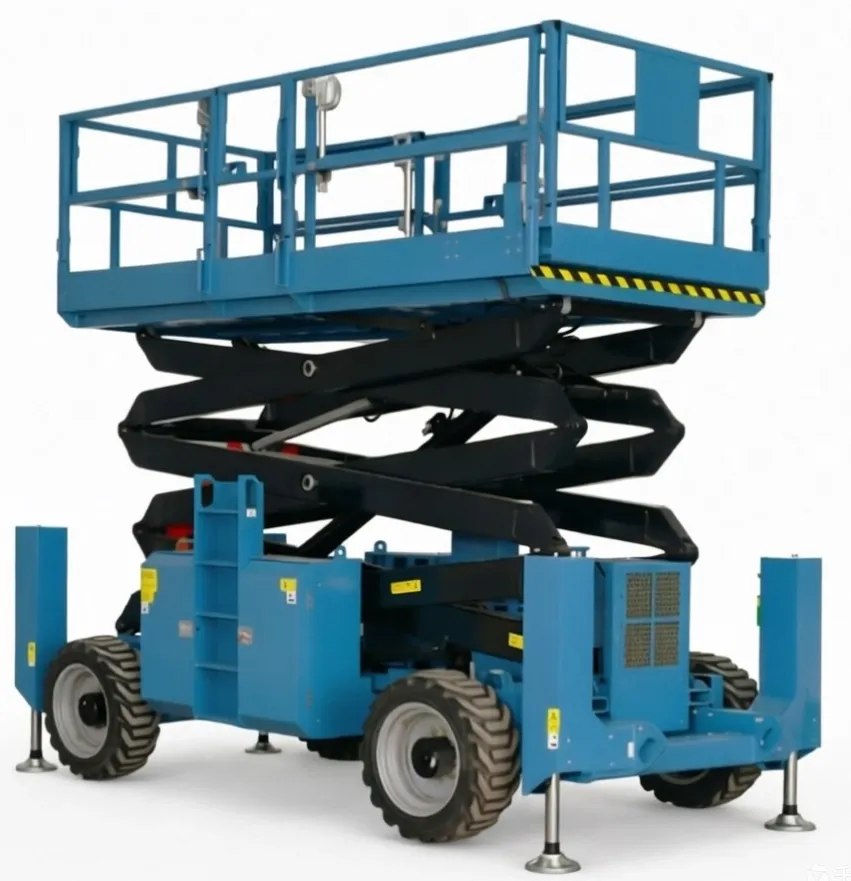
Outdoor yards on rough or sandy ground. This is crawler territory. Tracked machines spread their weight and hold traction on loose surfaces where wheels dig in, and they remain stable on slopes that would make a wheeled scissor nervous. For sites that mix flat slab and broken ground, a rough-terrain scissor lift with genuine four-wheel drive covers most tasks without the tracked undercarriage's transport considerations. If you are weighing tracked options, our crawler scissor lift buying guide compares the range.
Mixed indoor-outdoor duties in heat. An articulated boom lift with electric drive gives you the reach and articulation for maintenance work on building envelopes and industrial roofs, with the battery range to return to the charging bay. Specify the electrical enclosure ratings for your dust conditions before ordering.
Very high, very narrow working positions. Multi-mast vertical lifts handle the tall, tight jobs — mezzanine work, high racking — where a boom would not fit and a scissor cannot reach.
Across all scenarios, the deciding question is the same one: has this machine been configured for your climate, or for a catalogue photograph?
Keeping Machines Productive in 45 °C — Daily Habits That Matter
A correctly specified machine still needs a maintenance rhythm matched to the climate:
- Check hydraulic oil temperature and level daily in summer. Inspect for weeping seals weekly rather than waiting for scheduled service.
- Clean dust from cooling fins, filters and battery compartments far more often than a temperate-climate service manual suggests. Dust is an insulator; insulation is heat.
- Charge in shade or at night where the schedule allows, and keep charger vents clear.
- Rinse salt accumulation from coastal machines — undercarriage, fasteners and pivot points especially — and re-apply protection on schedule.
- Log intermittent electrical faults. In humid climates they are early warnings, not annoyances.
None of this is exotic. It is simply maintenance tuned to the actual environment instead of the standard checklist.
Why Buyers in Difficult Climates Need a Sourcing Partner, Not Just a Seller
This is where Outstrip Industrial works differently from a marketplace listing. We have been supplying aerial work platforms since 2014, and our team's experience in this industry goes back two decades — long enough to have watched machines fail in exactly the ways described above, in exactly these markets.
Every machine we ship is inspected before dispatch, against international standards, and our supplier base is deliberately smaller than a general marketplace because each partner is evaluated for materials, consistency and after-sales conduct. We configure for the destination: electrical protection for your dust conditions, battery strategy for your charging reality, paint and fastener specification for your coast. Every machine carries a 12-month warranty covering defects in material or workmanship.
If your next project is in a climate that punishes equipment, tell us the six site facts from the checklist above. We will recommend the machine type honestly — including the times when the honest answer is "you do not need to buy the bigger one."
Request a quotation → — or message us at info@outstripindustrial.com or on WhatsApp. Send your maximum working height, ground conditions and site temperature, and we will come back with a specific recommendation.
Related reading