Oct 26, 2026Buying Guides
Articulated Boom Lift vs Scissor Lift: Which One Fits Your Job?
Boom lifts reach up and over obstacles; scissor lifts carry more weight on flat ground. Compare reach, up-and-over clearance, capacity and terrain before buying.
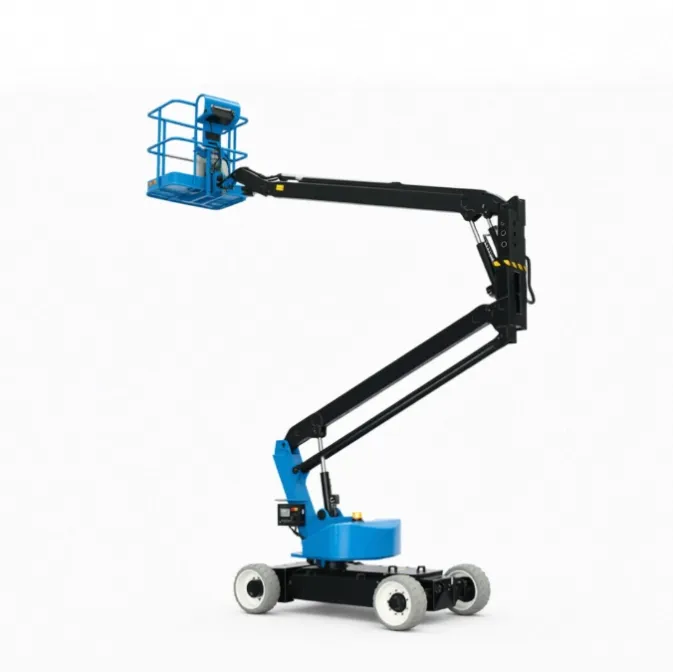
Buyers comparing an articulated boom lift with a scissor lift are usually asking the wrong question. It is not which machine is better — it is which machine your job actually is.
The two categories solve different problems. A scissor lift raises a platform straight up over a wide, stable footprint. An articulated boom lift reaches up and over, folding at one or more joints to clear an obstacle and put the platform where a scissor physically cannot go. Understanding that single distinction settles most of the decision before you reach a spec sheet.
This guide compares both types on reach, capacity, terrain and cost, explains the up-and-over clearance figure that most buyers overlook, and shows where each Outstrip model sits in the range.
What Each Machine Actually Does
A scissor lift raises its platform vertically on crossed linkages. The platform stays directly above the chassis, the deck is large, and the machine is at its most stable when fully raised on level ground. It is the right tool for horizontal work surfaces: ceilings, ducting, racking faces, facade panels, and any task where you want to walk along a long, wide deck with tools and materials around you.
An articulated boom lift mounts a platform on a hinged arm that rotates at the turntable and folds at the knuckles. That geometry lets the operator place the platform above, past, or around an obstruction — over a machine, through a gap between columns, above a mezzanine rail, or down into a pit. The trade-off is a smaller platform and a machine that must be positioned with more care.
The clearest way to hold the difference in your head: a scissor lift goes up, a boom lift goes up and over.
Side-by-Side: The Numbers That Matter
| Articulated boom lift | Scissor lift |
|---|---|---|
Working height range (Outstrip range) | 8.3 m – 17.7 m | 5.9 m – 18 m |
Platform capacity | 150 kg – 250 kg | 200 kg – 1,150 kg |
Platform size | Compact, 1–2 persons | Large deck, 2–7 persons |
Horizontal outreach | 4.2 m – 9.3 m | None — vertical only |
Up-and-over clearance | 3.1 m – 7.8 m | Not applicable |
Turning radius | 0 – 1.8 m inside | 1.55 m – 2.50 m inside |
Typical power | Electric (AC drive) or diesel | Electric or diesel |
Best ground | Firm, level; crawler models handle rough ground | Level slab; 4WD models for rough terrain |
Two rows decide most purchases. Outreach is the ability to work somewhere other than directly above the chassis. Capacity is how much you can bring with you. A scissor lift wins the capacity argument by a wide margin; a boom lift wins everything that involves a horizontal offset.
The Figure Most Buyers Miss: Up-and-Over Clearance
Up-and-over clearance is the height of the obstruction the boom can reach over while keeping the platform level. It is the number that determines whether the machine can access the work at all on a cluttered site.
Consider a factory floor with a production line between the operator and the wall that needs painting. A scissor lift positioned beside the line can only reach straight up. An articulated boom with 5.7 m of up-and-over clearance — the figure for the FBZ12E — can sit on the clear side of the line, fold its arm over the equipment, and place the platform against the wall.
If your site has pipework, conveyors, mezzanines, racking or machinery between the access point and the work face, measure the obstacle height and make it a hard requirement in your specification. A machine that lacks the clearance is not a compromise; it is unusable.
Matching the Machine to the Job
Choose a scissor lift when the work is directly overhead and the load is heavy. Ceiling and soffit work, mechanical and electrical installation, sprinkler and duct maintenance, facade panel fixing, and warehouse racking all favour a wide deck that carries two or three people plus tools. The electric SC series covers 5.9 m to 7.8 m working height with 230–240 kg capacity on a 0.76 m chassis — narrow enough for aisles and quiet enough for occupied buildings. Above that, the hydraulic-drive range runs 10 m to 15.7 m with capacity up to 450 kg, and the rough-terrain 4WD scissor lifts reach 12 m to 18 m with up to 1,150 kg and seven persons — genuinely a different class of machine, built on a 36 kW Kubota diesel with 40% gradeability.
Choose an articulated boom lift when the work is offset from where the machine can stand. Facade and cladding work, structural steel, signage and lighting, bridge and canopy inspection, and any job where a fixed obstruction sits between the machine and the work face. The folding arm turns an unreachable position into a routine one.
Choose a crawler boom when the ground itself is the obstacle. The FBZ-6T crawler-type articulated boom lift runs on rubber tracks with a zero turning radius and 25% gradeability, at 2,500 kg with a 30 L diesel tank. It is the machine for landscaped sites, gravel yards and slopes where a wheeled unit would struggle to position itself at all.
Inside the Outstrip Boom Range
| FBZ-6T | FBZ12E | FBZ16J |
|---|---|---|---|
Working height | 8.3 m | 13.5 m | 17.7 m |
Platform height | 6.3 m | 11.5 m | 15.7 m |
Horizontal outreach | 4.2 m | 6.8 m | 9.3 m |
Up-and-over clearance | 3.1 m | 5.7 m | 7.8 m |
Platform capacity | 150 kg | 215 kg | 250 kg |
Occupancy | 1 person | 2 indoor / 1 outdoor | 2 persons |
Drive | Rubber track crawler | 2WD AC electric | 2WD AC electric |
Power | Kubota D722-E3B diesel | 8 × 6V / 224 Ah AGM | 8 × 6V / 445 Ah AGM |
Stowed width | 1.54 m | 1.64 m | 1.89 m |
Machine weight | 2,500 kg | 3,735 kg | 7,385 kg |
All three share a 355° non-continuous turntable rotation and zero tailswing when raised, which lets the operator swing the platform into position without the counterweight sweeping into people or structures.
The selection logic follows the site, not the brochure:
- Tight, uneven ground; height under 9 m. The FBZ-6T — tracks, zero turning radius, 1.54 m wide.
- Most building maintenance and facade work. The FBZ12E is the workhorse: 13.5 m working height, 6.8 m outreach, electric drive with zero emissions indoors, and a 1.64 m stowed width.
- High structures with deep setbacks. The FBZ16J delivers 17.7 m working height and 9.3 m outreach, with 7.8 m of up-and-over clearance for genuinely awkward geometry.
If you are working in high ambient temperatures or dusty conditions, the specification questions change — we covered those separately in our guide to choosing a MEWP for hot, humid and dusty sites.
The Cost Question, Answered Honestly
A boom lift costs more than a scissor lift of similar working height. The articulated arm, turntable and counterweight system are simply more machine. Buyers who only compare purchase price often conclude that the scissor lift is the better value.
That logic holds only if the scissor lift can actually do the job. When the work requires outreach or up-and-over clearance, the alternatives are scaffolding, a rented boom, or not doing the work — and a machine that cannot reach the work face has no value regardless of its price. Buy the capability you need, then optimise on capacity, not the other way round.
Two other cost factors deserve a place in the comparison:
- Deck size affects labour. A wide scissor deck lets two people work together and carry materials up in one trip. A boom platform carries fewer people but reaches places that would otherwise need scaffolding built.
- Weight affects where the machine can go. A 2,500 kg crawler and a 7,385 kg boom impose very different floor loadings and transport requirements. On upper floors, mezzanines or weak slabs, check the point load before ordering anything.
If you are still narrowing the shortlist, our complete MEWP buying checklist covers the commercial questions — lead time, spare parts, commissioning and support — that sit behind every machine decision. And if you are tempted to buy a taller machine than the job needs, this analysis of the safety-margin trap explains why that usually costs more than it protects.
What to Verify Before You Order
- Reach at the working height you need. Maximum working height and maximum outreach rarely occur at the same time. Ask for the machine's working envelope, not just the two headline numbers.
- Certification and paperwork. Ask for the CE certificate and confirm its scope covers your configuration — our guide to CE certification for aerial work platforms explains what to check.
- Battery or fuel strategy. Electric booms suit indoor and urban work; diesel and crawler units suit remote sites without charging infrastructure. Match the power source to where the machine will actually operate.
- Warranty and parts. Outstrip machines carry a 12-month warranty covering defects in material or workmanship, and standard production runs about 30 days from deposit. Send the model and serial number for any parts enquiry.
Frequently Asked Questions
Can a scissor lift reach over an obstacle? No. A scissor lift raises its platform vertically, so the work must be directly above the chassis. If an obstruction sits between the machine and the work face, you need a boom lift, or you need to reposition the machine — which is often impossible on a congested site.
Which is safer, a boom lift or a scissor lift? Neither is inherently safer. Both are engineered platforms governed by the same standards, and both require trained operators, pre-use inspection and correct ground conditions. Scissor lifts are more stable at height by geometry; boom lifts require more attention to positioning and wind exposure. Our note on two sets of controls on MEWPs covers a safety feature common to both.
What working height do I need? Add roughly 1.8–2 m to the highest point you need to touch, to account for the platform floor and the operator's reach. Working height figures in this article already include that allowance; platform height does not.
Can a boom lift work indoors? Yes, with the right power source. The electric FBZ12E and FBZ16J produce no exhaust and suit indoor work; the diesel FBZ-6T is intended for outdoor and semi-enclosed sites. Wheeled booms also have tighter turning circles than most buyers expect — 0.91 m inside on the FBZ12E.
Do you offer customisation? Yes — OEM and ODM are both available, including battery upgrades, platform attachments and special colours. Tell us the working envelope you need and we will confirm what is achievable.
Ready to Shortlist?
Send us three things: the highest point you need to reach, the height of the tallest obstruction between the machine and the work face, and the ground conditions on site. Those three answers usually settle whether you need a scissor lift, a wheeled boom or a crawler boom — and which model in the range.
Request a quotation → — or email info@outstripindustrial.com, or message us on WhatsApp. Include your maximum working height, outreach requirement and site conditions, and we will come back with a specific recommendation.
Related reading